
What is the difference between shared and exclusive leads?
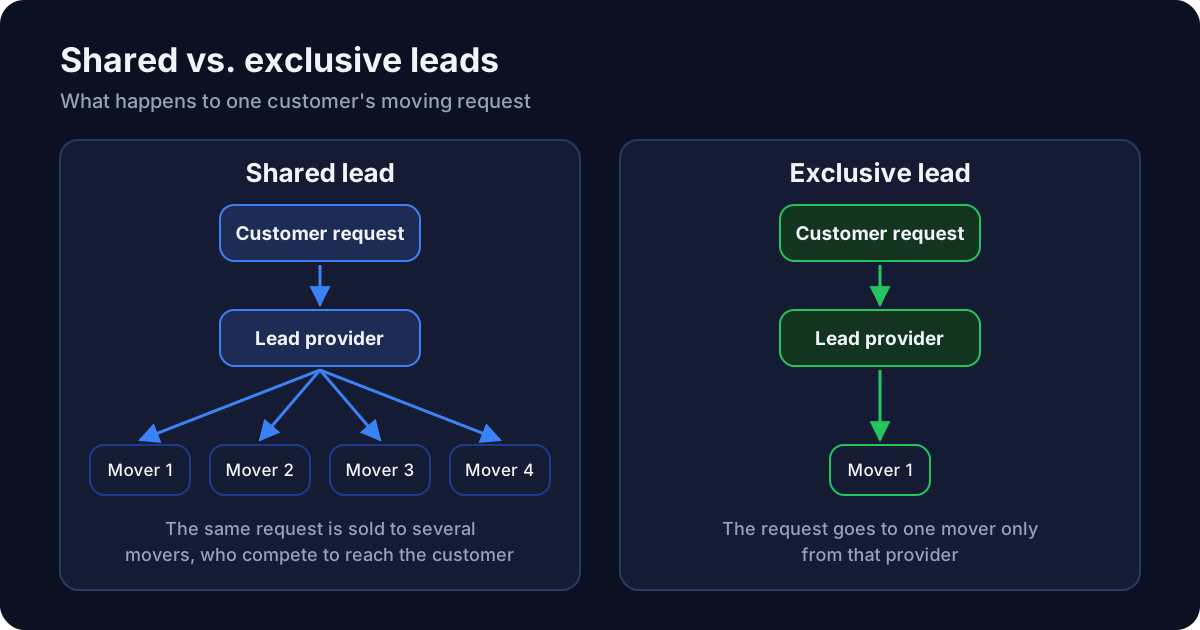
The difference is how many businesses receive the same customer inquiry:
- A shared lead is sold to more than one business. Every buyer gets the same name, phone number, and move details, and they compete to reach the customer.
- An exclusive lead is delivered to one business only. No other buyer receives it from that provider, although the customer may still contact other movers on their own.
Both usually come from lead providers: companies that run quote-request websites or ads, collect inquiries, and sell them to moving companies. Harvard Business Review described the model as "online brokerages that offer customers a simple way to get quotes from multiple companies and then sell the resulting leads to those companies."
How do shared and exclusive leads compare?
| Shared lead | Exclusive lead | |
|---|---|---|
| Who receives it | Several businesses | One business |
| Competition for the customer | Other buyers call the same person | No other buyer from the same provider |
| Response pressure | Highest; the first useful contact has the advantage | Still important, but no other buyer is racing |
| Price | Set by the provider | Set by the provider |
| What to check | Maximum number of buyers per lead | That exclusivity is written into the terms |
Prices and buyer counts vary by provider, market, and move type. Compare the cost per booked move, not only the cost per lead, because a cheaper lead that rarely books can cost more in the end.
Why does response speed matter more with shared leads?
When several companies receive the same inquiry at the same moment, the customer usually hears first from whoever calls first. Research on online leads published in Harvard Business Review found that firms that tried to contact a lead within an hour were nearly seven times as likely to have a meaningful conversation with a decision maker as firms that waited an hour longer. With a shared lead, that hour is shared with competitors. See what is speed to lead.
What should a moving company ask a lead provider?
Get these answers in writing before buying:
- How many companies receive each lead? For shared leads, ask for the maximum, not the average.
- Where do the leads come from? The websites, ads, or partners that collect them.
- What consent does the customer give? Ask to see the exact form language the customer agrees to.
- What is the return or credit policy? For wrong numbers, duplicates, and moves outside your service area.
- How fast are leads delivered? A lead delivered an hour late has already lost much of its value.
- Is exclusivity guaranteed? If a lead is sold as exclusive, the contract should say so.
What consent rules apply to calling and texting purchased leads?
The FCC's rules under the federal Telephone Consumer Protection Act (TCPA) restrict telemarketing calls and texts made with an automatic telephone dialing system or an artificial or prerecorded voice. For the telephone lines the rules cover, those calls require the called party's "prior express written consent," defined as a signed written agreement, which can be electronic, "that clearly authorizes the seller" to deliver those messages to a specific number.
In 2023 the FCC adopted a rule that would have required consumers to consent to one seller at a time, which would have limited how lead providers collect consent for multiple buyers. The Eleventh Circuit Court of Appeals vacated that rule in Insurance Marketing Coalition Limited v. FCC on January 24, 2025, holding that "callers must obtain 'prior express consent'—not 'prior express consent' plus." The FCC removed the rule in July 2025 and reinstated the earlier definition. The rule never took effect.
Other requirements still apply. The rules let a person revoke consent "by using any reasonable method," including replying "stop" to a text, and revocations must be honored within ten business days. State laws may add their own requirements. Whether a specific provider's consent is valid is a legal question for the business and its counsel.
How do Local Services Ads leads compare?
Local Services Ads work differently from lead providers. Google says customers pick a specific profile, so "you only hear from customers who have specifically selected your profile out of all the rest." That makes each Local Services Ads lead closer to an exclusive lead, although the customer can still contact other movers. See what are Local Services Ads.